Echolocation for All

Working with visually impaired individuals has made me acutely aware of the challenges that accompany the loss of sight. Yet it has also revealed the remarkable adaptability of the human brain. In a world that often privileges vision above all other senses, sound can become a powerful means of perceiving and understanding space. The pressure waves that constantly surround us, reflecting off walls, objects, and landscapes, carry a wealth of information that most of us rarely notice. Research into human echolocation has uncovered extraordinary abilities in some blind individuals, while also revealing insights that may be relevant to all of us.
Earlier this summer, while visiting Switzerland, I experienced a striking reminder of the limits of perception. It was unusually hot, so we left the large windows wide open in the evening. At some point, a bat flew into the apartment. For all the sophistication of her echolocation, she could not find her way back out. Eventually she disappeared from sight, and we went to bed. The next morning, we found her tucked into a corner of the bathroom. Using a towel, we gently picked her up and released her outside. What struck me most was that throughout the evening she must have been echolocating continuously, filling the apartment with bursts of sound. Yet we heard nothing at all, because the frequencies she used were far above the range of human hearing.
Human echolocation has enabled certain people, despite being completely blind from an early age, to ride bicycles, navigate unfamiliar environments, and even play sports such as basketball. These individuals learn to perceive their surroundings by producing sharp clicks with their tongues and listening carefully to the returning echoes. Subtle variations in timing, intensity, and timbre provide information about the size, shape, distance, and location of nearby objects.
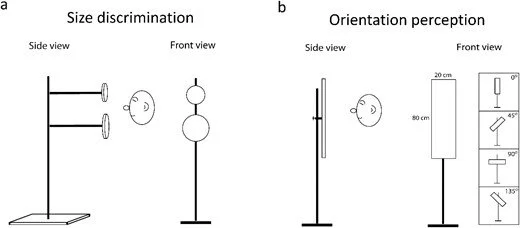
Practical echolocation tasks used in the 10-week training program. In the size discrimination task (a), participants judged which of two vertically arranged disks was larger. In the orientation perception task (b), participants judged whether the rectangular plank was vertical, right side up (45°), left side up (135°), or horizontal.
What makes this phenomenon particularly fascinating is what it reveals about the brain itself. Brain-imaging studies have shown that expert echolocators exhibit activity in the primary visual cortex while processing echoes. For many years, neuroscientists believed that sensory regions of the brain were largely dedicated to a single modality. The visual cortex processed vision, the auditory cortex processed sound, and so forth. Echolocation challenges this assumption.
In 2021, neuroscientist Lore Thaler of Durham University and her colleagues demonstrated that echolocation is not an exotic skill reserved for a select few. Their study showed that both blind and sighted participants could acquire meaningful echolocation abilities after only ten weeks of training. Participants first learned to produce effective mouth clicks and were subsequently trained to estimate object size, determine object orientation, and navigate virtual mazes using echoes alone.
The results were striking. Both blind and sighted participants improved substantially across all tasks. More remarkably still, brain scans revealed that members of both groups showed activation in the visual cortex when processing echoes. These findings suggest that the visual cortex may not be exclusively devoted to vision, but instead may contribute more broadly to our understanding of space, regardless of the sensory pathway through which that information arrives.
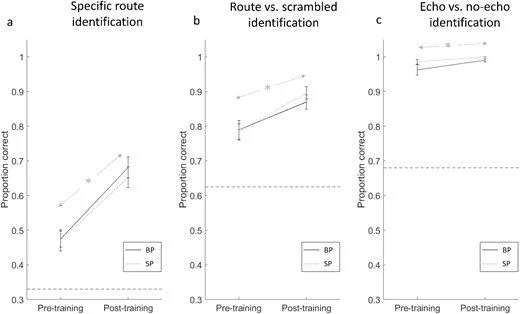
Data from the behavioral task, showing improvement in performance following training for blind peoples and sighted peoples. Three separate measures of performance are given: ability of participants to identify specific route types a), to identify coherent route sounds vs. scrambled sounds b), and to identify the sounds containing echoes from those that do not (c).
Such discoveries invite us to reconsider the way we think about perception. Rather than functioning as a collection of isolated sensory modules, the brain may be better understood as an integrated system whose ultimate purpose is to construct a coherent representation of the world. Vision, hearing, touch, and movement become different routes toward a common goal: spatial understanding.
As musicians, these ideas resonate deeply. It is not uncommon to see performers close their eyes during a concert. To an observer, this gesture may appear introspective or emotional, but it may also serve a practical purpose. By reducing visual distractions, musicians often become more attuned to the acoustic environment around them. The dimensions of the room, the placement of fellow performers, the character of reflected sound, and the subtle interplay of resonance and silence become more vividly apparent.
Experienced musicians spend thousands of hours refining their ability to extract meaning from sound. We learn to identify the location of instruments on a stage, to sense the acoustic properties of a hall, and to adjust our playing in response to the reflections that return to us from the surrounding space. While this differs from the deliberate tongue-clicking employed in formal echolocation, it raises an intriguing question: have musicians, through years of intensive listening, developed their own sophisticated form of spatial perception through sound?
The participants in Thaler’s study demonstrated that the human brain can rapidly learn to use echoes as a source of spatial information. If sighted individuals can acquire such abilities in a matter of weeks, one wonders what might emerge after decades of musical practice. Perhaps musicians are already engaging neural mechanisms that parallel those of trained echolocators. Perhaps the sensation of “feeling” a room through sound is more literal than metaphorical.
The growing body of research on echolocation reminds us that perception is not fixed but profoundly adaptable. The brain continuously seeks new ways of understanding the world, drawing information from whatever sources are available. For musicians, whose art is rooted in attentive listening, this research offers a compelling possibility: that every rehearsal, every performance, and every moment spent immersed in sound may be shaping not only how we hear music, but how we perceive space itself.