Eclipses: now you see them, now you don’t.
Last month we had both a solar eclipse and a lunar eclipse, and since these events are still fresh in our minds, I thought I would dig a little deeper into this phenomenon than the usual press release.
Yes, they always come in pairs, with a cycle that lasts 18.6 years. This happens because the plane of the Moon’s orbit around Earth is tilted almost six degrees (5.8°) from the ecliptic, the plane in which the planets orbit the Sun. When the Moon’s orbital plane crosses the ecliptic, it creates two points called nodes. Since the Sun resides at the center of the ecliptic plane, when the Moon crosses one of these nodes, roughly every 173.3 days, a solar or lunar eclipse becomes possible. In other words, shadows can cross when the nodes coincide with a full or new Moon, and the Sun, Earth, and Moon align in three dimensions.
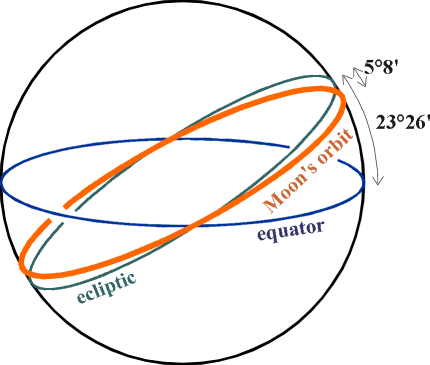
Added to the ecliptic and the Moon orbit in this graphic is the Earth equator.
The Moon crosses the ecliptic twice during each orbit; this is why the lunar and solar eclipse occurs as a pair. But most of the time that crossing does not coincide with the line of sight to the Sun. This is due in part to the motion of the Earth, which, as it carries the Moon around the Sun, causes the nodes of the Moon’s orbit to slowly travel through the sky until they reach an alignment with the three bodies—Earth, Moon, and Sun—and create the conditions for an eclipse of either kind. An alignment of three or more celestial objects is called a syzygy.
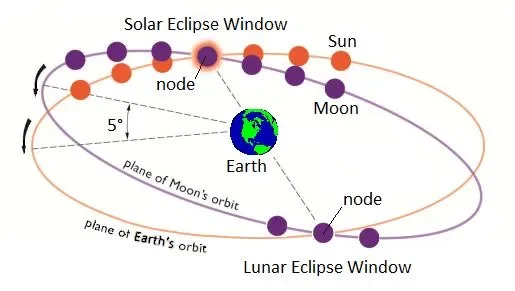
The nodes are shown here; note the lunar and the solar eclipse windows that coincide when the nodes are aligned.
The two circles created by the Moon’s orbital path around Earth and the ecliptic mean that the Moon is above the ecliptic for part of its orbit and below it for the other part. For a full solar eclipse, the alignment must be extremely precise; for a lunar eclipse, the alignment can be slightly less exact. On top of that, the Moon’s orbit is not a perfect circle, so its distance from Earth is not always the same.
These variations account for the different kinds of eclipses: partial, total, and annular solar eclipses, and penumbral, partial, and total lunar eclipses.
I hope this is not too confusing, but since everything is in motion, the closer we look, the trickier it gets. On the other hand, there is something calming about witnessing, in real time, the awesome forces revealed by the motion of celestial bodies—free from the “chicanery” of the human race.