
1. Amarilli mia bella 4:32 (G. Caccini: Italy, XVI Century)
2. Come Away, Come Sweet Love 4:19 (J. Dowland: England XVI C)
3. Exulta filia sion 6:12 (C. Monteverdi: Italy, XVII C)
4. Il mio cocente ardore 4:07 (G. Felice: Italy, XVII C)
5. Dido’s Laments (From Dido & Aeneas) 5:49 (H. Purcell: England, XVII C)
6. Usurpator tiranno 6:13 (G. Felice)
7. The Fatal Hour 4:26 (H. Purcell)
8. Sir 4:57 (Anonymous: Spain, XVII C)
9. Orphee 2:33 (L. Rossi: Italy, XVII C)
10. Can He Excuse My Wrong? 4:08 (J. Dowland)
Arranged by: Goodsall / Pillow / Wagnon (tracks 2, 3, & 5), Pillow / Wagnon (4, 6, & 10),
Goodsall / Pillow (1 & 8), Pillow / Jones (9), & Goodsall (7).
Guest musicians:
Beverly Au – treble & bass viols (on 5 & 9)
Chris Speed – clarinet (on 6)
Produced by Marc Wagnon.
Recorded & mixed by Marc Wagnon & Matt Hathaway at “Buckyball M” studio: summer 2000, NYC.
Mastered by Fred Kevorkian at “Absolute Audio” in the fall of 2000, NYC.
Recorded at Buckyball Music Studio May & June 2000
Mixed at Buckyball Music Studio July 2000
Mastered at Absolute Audio by Fred Kevorkian
Recording engineer: Marc Wagnon
Mixing engineer: Matt Hathaway
Executive producer Marc Wagnon
©2000 Buckyball Music, Inc.
Photographs: Fred Rüegg
Cover design: Messischmidt.ch
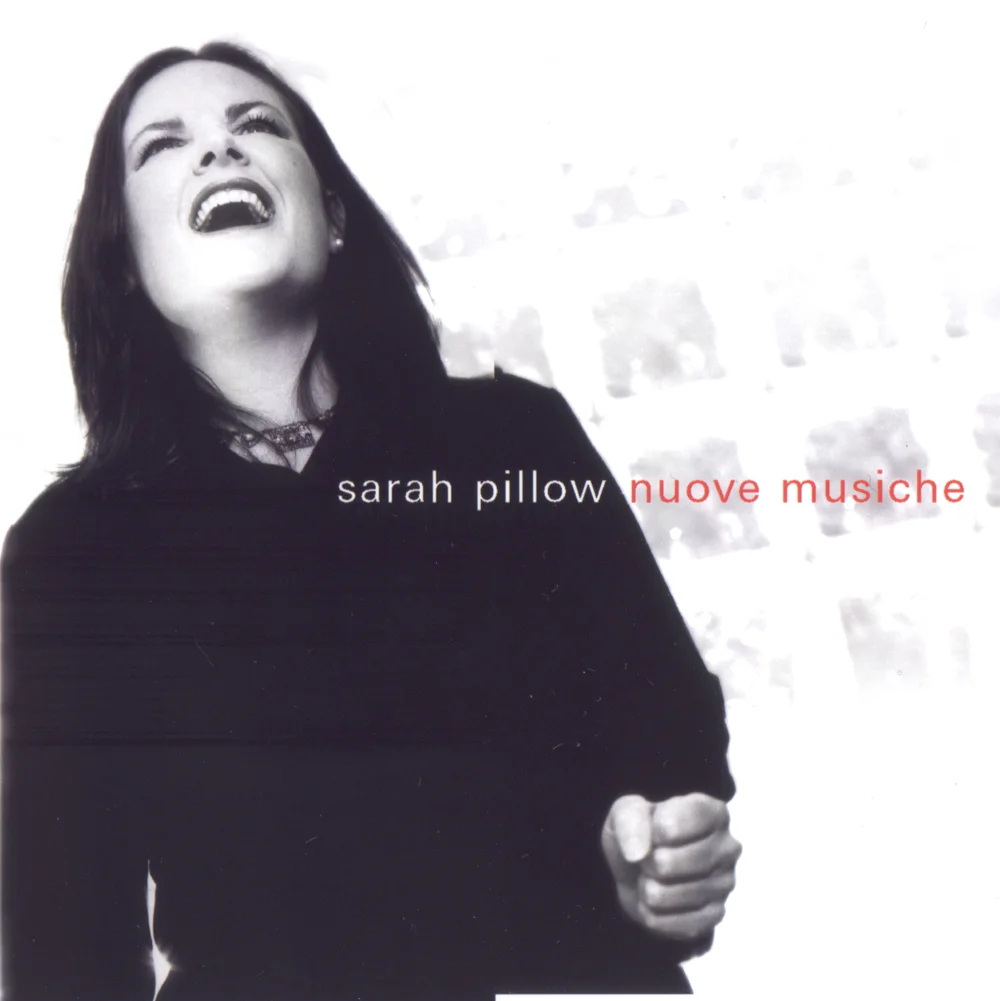
Sarah Pillow "Nuove Musiche"
The title "Nuove Musiche" is Italian for "new music". Taken from Giulio Caccini's collection of songs from the early 17th century, the melodies and texts have been returned to the 21st by the forerunners of progressive rock and jazz.
"Not for the narrow-minded"
"... Many talents to accompany that superb voice. "Amarilli Mia Bella" (Amarillis, My Beauty), where a picking guitar, filled with effects kind of reminds you of a heavy metal song. But instead of rising to a thunderous chorus, a classical guitar is played marvellously."
"The overall sound is extremely fresh, while remaining classical at the same time. Extremely innovative." - guitarnoise.com
Full Reviews
Multitalented vocalist Sarah Pillow veers off the straight and narrow with this immensely absorbing release titled Nuove Musiche, which in Italian, signifies ‘new music’. Here, Ms. Pillow melds Baroque compositions with fusion, progressive rock and blues motifs, all sung in Latin, French, Spanish, English and/or Italian. A striking concept indeed, as the artist aligns her impressive vocal faculties with the eminent fusion/progressive ensemble, “Brand X”. On this outing, the music of 17th century composers such as Purcell, Monteverdi, Rossi and Dowland cross paths with one of the hardest driving bands in the business amid Ms. Pillow’s silken incantations and conspicuously stylistic approach. Throughout, the vocalist renders romantic lyricism in various dialects atop thrashing blues choruses, sublime synths and electric guitarist John Goodsall’s blistering chord progressions and semi-classical accompaniment performed on acoustic guitar. Meanwhile, vibist, multi-instrumentalist Marc Wagnon, bassist Percy Jones and drummer Frank Katz lay down the thunderous or at times, delicately constructed rhythms. Hence, an intriguing and somewhat surrealistic fusing of disparate elements and contrasting modes of execution, as the band fabricates interweaving fabrics of sound in concert with Ms. Pillows resonant vocals and lilting arias. No doubt, this recording will spur some debate yet when viewed upon as a whole, Nuove Musiche is a compelling project, brimming with emotional story lines and melodious themes. Basically, Sarah Pillow navigates previously uncharted sectors on this curiously interesting excursion!By Glenn Astarita - All About Jazz
Percy Jones plays a magnificent bass. His fingerwork on the broad strings is unique and astonishingly expressive. But that's not the focus of this unusual recording. Sarah Pillow has sung jazz, jazz-rock, and opera. Her talent lies in her voice. This clear, bright alto captivates with its directness and sheer simplicity. John Goodsall (guitar), Percy Jones's former bandmate Brand X, arranged and played on the album. Marc Wagnon on vibraphone, keyboards, samples, and percussion, and Frank Katz on drums complete the band. They translate 11 songs, which originate in the 16th and 17th centuries, into the modern era. Jazz-rock, funk, and a poppy sense of rhythm carry the vocal lines, which are laid over the band's original arrangements. Some operatic elements, several folkloric ones, and completely atypical rock moments resonate throughout. Especially when Sarah trembles on "Jubilate Deo," an unsettling feeling settles in my ears. But the band never gets lost in awkward moments. With flowing pop structures, guitar solos, and samples, they take control and thus anticipate static moments that could easily arise from the vocals alone. Volkmar Mantei - Ragazzi
Fascinating attempt to fuse Baroque and jazz. This is not quite as it seems. The concept was to make contemporary treatments, "poppy" in parts, of classical charts / libretti resulting in an eclectic album of pop, jazz, rock and progressive rock. It is most pleasing when rapid-fire Latin-inspired guitar and vibes licks snake around Sarah Pillow's angelic voice, not a classic falsetto but an impressive range, however, her vocal dynamics (particularly vibtrati) sometimes conflict with the modern setting. The progressive rock element is understandable on learning that Brand X provide the support, with John Goodsall's guitar runs at times John McLaughlin and Carlos Santana-inspired, and Percy Jones' bass fiery and swerving. Nuove Musiche doesn't quite make the fusion as achieved by Garbarek's Officium and Mnemosyne, but good fun all the same. Angelfire.com "Julian F. Derry"
I wish I had heard this before writing last month's editorial. This is an extraordinary (and extraordinarily convincing) blend of 17th century songs with modern (I use the word to contrast with 17th-century) jazz. The vocal lines are more or Iess as written, sung by someone who has specialised in 17th-centrury performance, but with a new rhythm and, often, with increasing freedom and variation as the song progresses. The inventive accompaniments are new, not usually referring much to the origınals, but creating something fresh. They make the John Potter/Barry Guy Dowland disk seem positively conventional. There is plenty of vigour, and the occasional sultry number. The only item that doesn't work is Dido's Lament: Purcell's vocal line doesn't make sense when separated from the ground. But apart from that, for a listener who is fairly innocent of jazz this is a real success. Cliffort Bartlett Early Music Review
This is an intriguing record. Sarah Pillow has recorded versions of 17th century songs from various sources. The arrangements vary greatly and that makes for intriguing listening. Pillow, aided by musicians from Brand X, is really onto something. "Come Away Sweet love" by John Dowland is done as a contemporary pop song. It's very catchy and sees the versatile Pillow singing sweetly. Monteverdi's "Exulta, Filia Sion" is done in a jazzy stlye with the musicians showing their skills at full blast. Pillow alters between opera diva and lounge singer styles. Henry Purcell's "Dido's Lament" is done almost heavy metal style and it works. Pillow's pure vocal meshes well with the loud guitars. The evocative reading of Purcell's "The Fatal Hour" is beautiful. Pillow's voice is allowed to shine. This record demands a listener with an open mind and for such a listener it is a treasure. a Review by Anna Maria Stjarnell
Sarah Pillow's solo album "Nuove Musiche" from 2000 contains musicians from Shadowlines and Tunnels: John Goodsall - guitar, Percy Jones (Brand X, Tunnels) - bass, Frank Katz (Brand X, Shadowlines, Tunnels) - drums, Marc Wagnon (Brand X, Dr. Nerve, Shadowlines, Tunnels) - vibes, keyboards & percussion. In 1602 there was an Italian composer named Giulio Caccini who completed a volume of songs entitled "Nuove Musiche" (nuovay muzeekay / the new music), and this is said to have opened the door to modern songwriting. Personally I haven't heard nothing about this "fact", but Sarah has taken this as a starting point for this album and recorded songs from 16th and 17th century composers with modern baroque/jazz/progressive rock arrangements. At first I was skeptic about what I heard, but after 2-3 listenings I started to like it. The vocals are singed in Italian, French, Spanish, English and Latin. Not everybody's cup of tea, but if you take the time and listen to it a couple of times, there's a good chance that you'll end up liking it as much as I do. And Sarah's voice is as beautiful and powerful as always. Expand you're musical barriers and listen to this album. Reviewer: Greger Rönnqvist
Not for the narrow-minded I must admit that I was quite reluctant to put this CD on. The press kit announced that it was a mix of Baroque, Jazz and Progressive Rock. Baroque, for those of you who aren’t all that familiar with Classical music, is what Beethoven used to do... Although Progressive Rock is a mix of Classical, Rock and Jazz, this is in an altogether different direction. On the one hand I was excited at the possibilities offered here. On the other, I was a bit scared at the result. Well, my hat goes off to Sarah Pillow! And to Buckyball Records for sensing the enormous potential in this lady and this genre. Nuove Musiche (The New Music) finds its title in a songbook written by Giulio Caccini in 1602. It was an important song book and Sarah wanted to use it as an introduction to this musical project. Now the whole thing sounds a lot like a Rock band playing Classical music. Although it manages to retain a modern sound. As if the music was written yesterday. All of the songs on this album were written between the 16th and 17th centuries. The lyrics are often in Italian, while at other times you’ll hear French and English (The folks at Buckyball were nice enough to translate them all in English in the booklet. Judging from the translated French, as I can read the original, it has been well done). Many talents to accompany that superb voice. “Amarilli Mia Bella” (Amarillis, My Beauty), where a picking guitar, filled with effects kind of reminds you of a Heavy Metal song. But instead of rising to a thunderous chorus, a Classical guitar is played marvellously. A great introduction to the album. “Dido’s Lament” is another beauty of a piece. Filled with distorted electric guitars, without ever going overboard. Always hinting at something very powerful. A powerful lament, indeed! The only two tracks I was a little less enthused about were the fourth (Il Mio Cocente Ardore) and the last (Can He Excuse My Wrongs?). Not that they aren’t good, they are. Only these are straightforward Jazz pieces that seem out of place on this particular album. The overall sound is extremely fresh, while remaining Classical at the same time. Extremely innovative. There’s even a cow in there somewhere... (Really, there is!) Very well done. Hopefully, this style will become more popular and Ms. Pillow will give us more of it. A-J Charron 2001-08-15
Known for her work in both Baroque music and jazz, vocalist Sarah Pillow is now combining the two and leading them into brand-new territory. Along with John Goodsall, Percy Jones, Frank Katz and Marc Wagnon of Brand X, she has recorded a CD that offers jazz, rock, and fusion versions of 17th – century songs. The result is as varied as it is unusual. Giovanni Felice Sances’ “Il Mio Cocente Ardore” and John Dowland’s “Can He Excuse My Wrongs?” are given a straight jazz treatment, “Come away, Come Sweet Love” (also by Dowland) is transformed into accessible pop, while Henry Purcell’s “Dido’s Lament” is interpreted as driving, hard-edged funk-metal with goth leanings. Other tunes lie variously in the realms of fusion, alternative, jazz-rock, and prog, with the occasional nod towards more traditional arrangements (especially on Luigi Rossi’s “Orpheé”). Though diverse, the eleven tracks are given unity through the baroque melodies and by Pillow’s superb singing, which effortlessly moves back and forth (in five languages) from jazz scat to operatic coloratura to a grittier rock delivery. Though Nuove Musiche is primarily Pillow’s show, the contributions of the Brand X lads are substantial. Most tunes are co-arranged by either Goodsall or Wagnon, who get their share of solos- and Jones’ bass work is as impressive as ever. I can’t think of any obvious points of comparison, but anyone who enjoys outstanding female vocals, jazz-rock fusion, or radical reinterpretations of early baroque music will probably love this. – Jim Chokey