
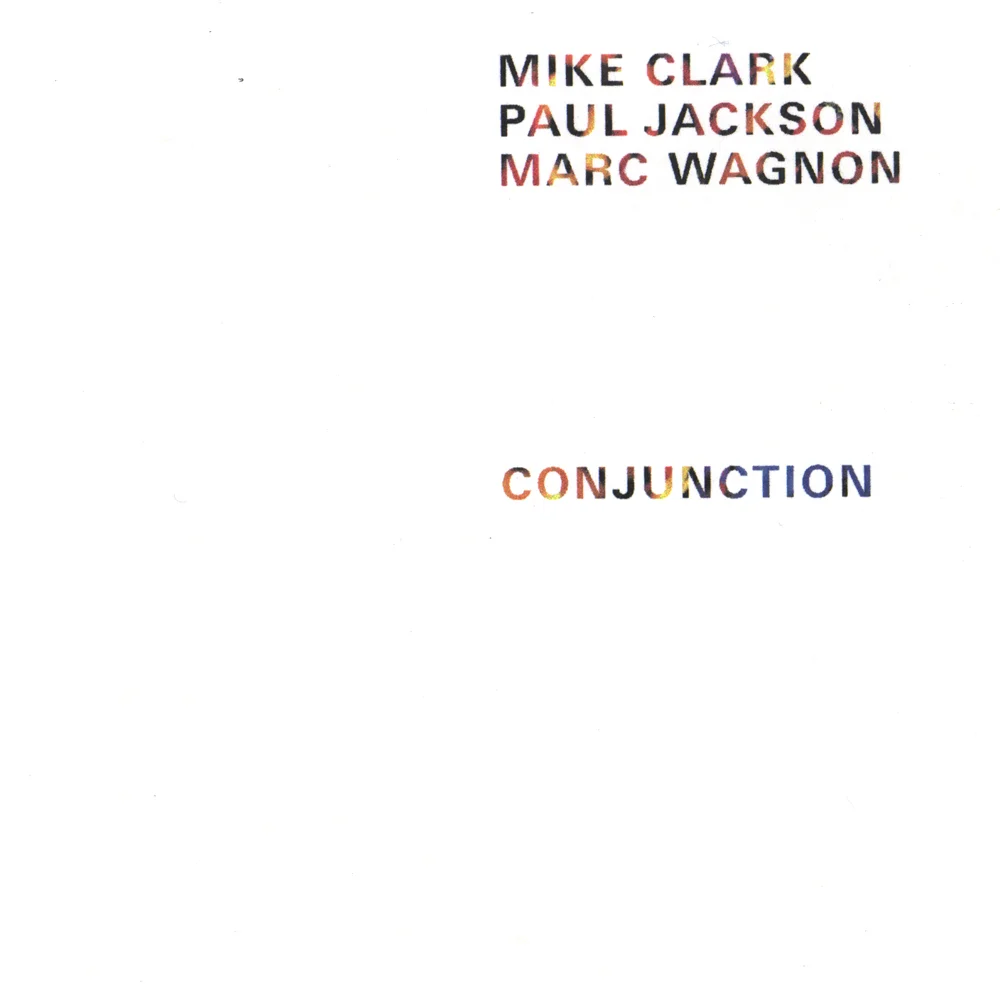
Marc Wagnon, Mike Clark & Paul Jackson "Conjunction"
Herbie Hancock's Headhunters rhythm section, Mike Clark and Paul Jackson, team up with Brand X and Tunnels electronic vibist Marc Wagnon to form "Conjunction". Add Dave Fiuczynski on guitar, Chris Speed and Jed Levy on reeds, and Josh Roseman on trombone and you make a hard swinging, funkadelic jazz cocktail.
Now here's something interesting. Two of my favorite jazz musicians together again on the Clark - Jackson - Wagnon album "Conjunction", released on the Buckyball label in 2001. We're talking about the two super- musicians Paul Jackson (bass) and Mike Clark (drums), both previous members of Herbie Hancock's band who released two of the best jazz albums ever: "Headhunters" from 1973 and "Thrust" in 1974. I simply love these two albums as well as Paul Jackson's solo album "Black Octopus" from 1978 and Mike Clark solo album "Actual Proof" from 2000. On "Conjunction" they have teamed up with vibraphone player Marc Wagnon (Brand X, Dr. Nerve, Shadowlines, Tunnels) and a bunch of other musicians, and together they have recorded a really enjoyable jazz-fusion album. Not as good as "Headhunters", "Thrust" or "Black Octopus", but it would be unfair to compare "Conjunction" with these all-time classics. Of course the album have resemblance's with the participation musicians previous bands, and with such an impressive back-catalogue it just can't go wrong. I hope that we'll see more albums from this constellation in the future. Greger Rönnqvist,
What happens when you put Herbie Hancock's rhythm section (Mike Clark and Paul Jackson) up against Marc Wagnon (vibe man for Brand X and Tunnels), and glue in guitarist Dave Fiuczynski, reed blowers Chris Speed and Jed Levy, and Josh Roseman on trombone? Well, the press pack says you get a 'hard swinging, funkadelic cocktail.' Could be. But more importantly you are given a jazz fusion hot foot that slowly climbs up your leg and ass and soon has your entire shaking like multiple schlorosis. The great thing about fusion, when it enlists a funky Fiuczynski guitar like this, is that Jeff Beck and The Lonely Bears and most of the best progressive rock comes out for a stomp like a 70s reunion of lost and found souls. No track better illustrates this than 'Gus' by Neal Kirkwood. A little name for such an ambitious pace of prog pop jazz, but wait'll you get into Marc's midi vibe backing, and the Mike drum solo that seems to take over the track like a Body Snatcher at times. When this ends, an emptiness comes on strong - But only for a few brief seconds. Then we are into the smooth night jazz side of Jed Levy on a sax so sleepy it's falling from the lips. The rather militant drum roll that begins the piece slacks off to fall in lazy stride with the vibes that feel by sight and smell. It is a cut groping for the light switch and finding a fish tank. I can't say enough about this instrumental cd. Thanks, Buckyball Records. And thanks for being an artist-run label, letting the PLAYERS have some say in how it all looks, sounds, sells. If they keep stocking brilliance like Conjunction, Blue Note and the big boys are going to have to bring shoehorns to get into the cool section of Tower. Ben Ohmart.
Wagnon are Brand X alumni, and thus an interesting intersection point. Besides the obvious links to Pierre Moerlen's Gong, the group treads alternative jazz waters by balancing instrumentation between songs. Vibes player Wagnon is the primary composer on the disc with four of his pieces including the album's flashy opener, ~Faster Than Light.. The brass section of trombonist Josh Roseman and Chris Speed create a distinct counterpoint that is crafted and interactive. Tenor sax player Jed Levy supplies three differently styled songs that in part are characterized by Wagnon's use of MlDI-vibes (with an electric piano setting). The most noteworthy of these is ~East West~ which recalls the charts of Bill Evans or even Don Sebesky's 70's output. On that track, lead guitar and sax begin with unisons before Levy transitions in with his smooth Iyrical approach. By and large, the ensemble as an entire unit is loose, with admirable restraint on soloing. The title track is the most notable on the disc due in no small part to John Fiuczynski's guitar playing which reminds me of the best of John Goodsall's 1970s catalogue or Henry Kaiser's slide playing. Overall, the disc is a great example of how fusion is trying to adapt to match a musical horizon that is in a state of flux - Jeff Mellon Exposé.
Led by the three musicians whose names grace the spine, Conjunction revolves around the musician's shaky, M Base-like rhythmic concept. Mike Clark's kit is the seminal element, shifting time and filling space. Paul Jackson edges in with his bloodlessly funky electric bass, and vibist Marc Wagnon makes sure that the harmonic aspect to the music stays as percussive as possible. Saxophonists Jed Levy and Chris Speed, trombonist Josh Roseman and electric guitarist Dave Fiuczynski all drop in and play on multiple tracks, but the eponymous rhythm section fashion the music's core (with occasional help from Fiuczynski). On his occasional solo turns, Speed goes his own way, but thanks to Roseman and Fiuczynski, the music never really veers from a brawny, busy and thick fusion sound. The themes are long, complex and not entirely easy to warm up to; the soloists aren't given a lot to chew on; and the rhythm section seems only tenuously attached to its front-line horns—at times it sounds as if they're playing in different rooms. The better tunes on the recording tend to better integrate Clark, Jackson and Wagnon with the rest of the band. The title tune, based around an ostinato pattern in Wagnon's vibes, does just that. The music on Conjunction manages to wring all the booty-shaking impulse out of funk rhythms, which makes it a more interesting listen than an enjoyable one. —Aaron Steinberg JazzTimes. As jazz/rock fusions go, Conjunction is something special: it completely refuses to fit into either category. The arrangements are too tight and the improvisation is too sophisticated to label this disc as rock, but the grooves are so backbeat-driven that one could never call it jazz. (Make a special exception for "The Unknown Shuffle," which is quite clearly exactly what it says it is: a blues shuffle.) Drummer Mike Clark plays a dominant role defining the group sound on Conjunction. His simmering rhythms propel improvisers forward, maintain interest through arranged sections, and occasionally burst into full flower in scattered drum solos. Since Conjunction is so grounded in rhythm, Clark's role is especially important. Of course, the rest of the band includes all-stars from all different walks of life. Particularly bright orbs include guitarist Dave Fiuczynski and saxophonist Chris Speed. Fiuczynski generally plays a respectful supporting role, but when he unleases his axe (as on "Gus") he propels the group into otherworldly space. Speed, who has a lot of experience playing avant jazz, also brings a welcome sense of forward-looking melodicism to the group. The compositions on Conjunction, mostly originals, cover the ground from dreamy melancholy ("Horta-Culture") to edgy funk ("East West") and restless energy ("Faster than Light"). The arrangements offer a balance between notated themes interspersed with individual improvisation. The only drawback to Conjunction is the relative restraint shown by soloists, who don't get a lot of time to stretch out. But perhaps that's not the point: this is a group record, and a tight one at that. By Nils Jacobson Allaboutjazz.com.
Something rare in jazz, Conjunction is billed to a rhythm section: drummer Mike Clark, bassist Paul Jackson, and vibraphonist MarcWagnon, although the latter gets a leading role in this outfit, thanks to his great technique and his use of MIDI-vibes to expand the soloing range of his instrument. This trio is completed by four guest musicians: guitarist extraordinaire David “Fuze” Fiuczynski, tenor sax Jed Levy, trombonist Josh Roseman and reedist Chris Speed. This impressive line-up can be reduced to a quartet “Horta-Culture” and go up to a sextet (on five tracks). If one takes out the post-bop ballad “Horta-Culture,” the music on this CD lies somewhere between Pierre Moerlen’s Gong and the Chick Corea Electrik Band, although funkier than any of them. “East West” and Conjunction” provide the most satisfactory moments: a driving rhythm section, hot brass licks, nice guitar. Fiuczynski sounds shy on this album: his work remains rather uninvolved, a feeling reinforced by the fact that his guitar is kept low in the mix. Otherwise, Conjunction makes an enjoyable album both for casual listening and for close-up inspection (you can spend hours studying Wagnon’s intricate patterns). Not best-of-the-year material, but a job well done. François Couture All Music Guide. If only all albums would start as powerful as this! Drums, bass and vibraphone create an ultra-exciting Jazzrock at the first downbeat. Mike Clark and Paul Jackson are the package of rhythm of Herbie Hancock's Headhunters. Marc Wagnon, for Rock and Jazz today, is spinning what Ruth Underwood, Mireille Bauer and Benoit Moerlen had been before. In the past he played with the AvantJazz-Rockers Dr. Nerve, and today he works with his own projects like "Tunnels", under his own name or in the continuation of Brand X. Therein comes Dave Fiuczynski (guitar), Jed Levy (tenor sax), Josh Roseman (trombone) and Chris Speed (sax, clarinet). The ten pieces of music range in the sphere of Jazzrock/Fusion, without varying experimentally. This would augur poorly If the musicians were bad. But with this top-class cast? all of them are excellent musicians before the Lord- so this is no problem. Here are some elements of Funk, theresomewhat of Modern Jazz . The influences of each musician gives "Conjunction" an agility, no way to work to gravely. Beneath the rhythm division becoming wild the vibraphone first of all provides a pleasure of hearing. The soli of the guitar and the horns cap the pieces of music. Sporadically the Jazz has afloat a bit, if the blowers draw the figures of rhythm or they start a kind of session threesome coming from Jazz with melody and interpretation. Marc Wagnon is bringing Jazzenamored Rockalbums on the market, stamped by his vibraphone or the Midi Vibes. Thereby are like at Sarah Pillow purely unequal appendages pushing him on to pipe up. Marc Wagnon is not to think away from theJazz/Rock scene. Volkmar Mantei Ragazzi,
The Mike Clark / Paul Jackson / Marc Wagnon trio (released on Buckyball Records) is another excellent recording effort from the American label founded by Swiss vibraphonist Marc Wagnon and his wife, Sarah Pillow. The freedom afforded by the lack of intermediaries between artists and listeners is perfectly managed on these consistently focused albums, ready to embrace intuitions and structures that continually renew and thrive on high-level cultural influences and great instrumental virtuosity. Mike Clark and Paul Jackson (drummer and bassist, respectively) are a dream rhythm section, leaning heavily toward the funky genre, which became famous especially for their stint with the Headhunters, the rock-solid group that Herbie Hancock created in the early 1970s. Their textures are dense, dry, and incredibly hard, a true rhythm machine that always knows how to provide unstoppable momentum without sacrificing flexibility. Caught in this impulsive whirlwind, Marc Wagnon gives his all with his vibraphone, always pushed to the limit, both in terms of instrumental technique and technological possibilities, given that his instrument enjoys a perfect MIDI implementation that allows him to control the sounds stored in expanders and computers, much like a keyboard player. To make the dish even more delicious and varied, four guests alternate on all the tracks, often overlapping. And they are guests of absolute caliber: from David Fiuczynski on electric guitar to Jed Levy on tenor sax, from Josh Roseman on trombone to Chris Speed on tenor sax and clarinet. The guitarist engages in both appropriate rhythm parts and searing solos, which are also the prerogative of the three wind instruments. This isn't simply the funky jazz-rock that is part of the rhythm section's DNA. The compositions are intricate, full of rhythmically fragmented and anomalous parts, multi-ethnic influences, digressions into experimental areas, and luxurious timbral blends. An original and impetuous path to true fusion of the new millennium. MAURIZIO COMANDINI Allaboutjazz.com.
Powerful as a rock album, rich with arrangements and improvisations typical of jazz, Conjunction, Mike Clark's new album, is incisive from the very first bars. The trio of the drummer (who boasts collaborations with musicians such as Herbie Hancock, Chet Baker, Tony Bennett, Wayne Shorter, etc.), bassist Paul Jackson (one of the institutions of electric jazz and formerly Clark's partner in the rhythm section of Herbie Hancock's Headhunters), and vibraphonist Marc Wagnon (who, after playing in groups such as Dr. Nerve, has recently embarked on a solo career), is joined by some of the most sought-after names on the downtown New York scene—David "Fuze" Fiuczynski, Jed Levy, Josh Roseman, and Chris Speed—allowing for great dynamism in the development of the arrangements, moving from the quartet of "Horta-Culture" to the five-song sextet of the album. Clark's presence is dominant within this project, not only for the rhythmic structure he creates, capable of maintaining high tension throughout the phrasing of the other instruments, but also for his solo interventions, and—from the first listen—you realize the great importance they have in the structure of the songs. When the drums explode into violent rhythms, the vibraphone and wind instruments respond with melodic phrasing, and the guitar, which fulfills its role well in the passages where it is only meant to be an accompaniment, is capable of drawing the rest of the group towards sounds as powerful as they are clean with its solos. The musical landscape explored on the album moves from the almost funky rhythm of "East West" to the power of "Faster than Light" (the opening track), through the delicacy of "Horta-Culture," and the sound the group creates is compact, complete, within which each instrument has the opportunity and capacity to express itself and assert itself without ever suffocating the others. The album moves quickly, is enjoyable upon first listen and through the in-depth study of the various passages. It's innovative, and the solos alternate with the written themes without tiring or weighing down the song structure. Luca Corte Rappis.